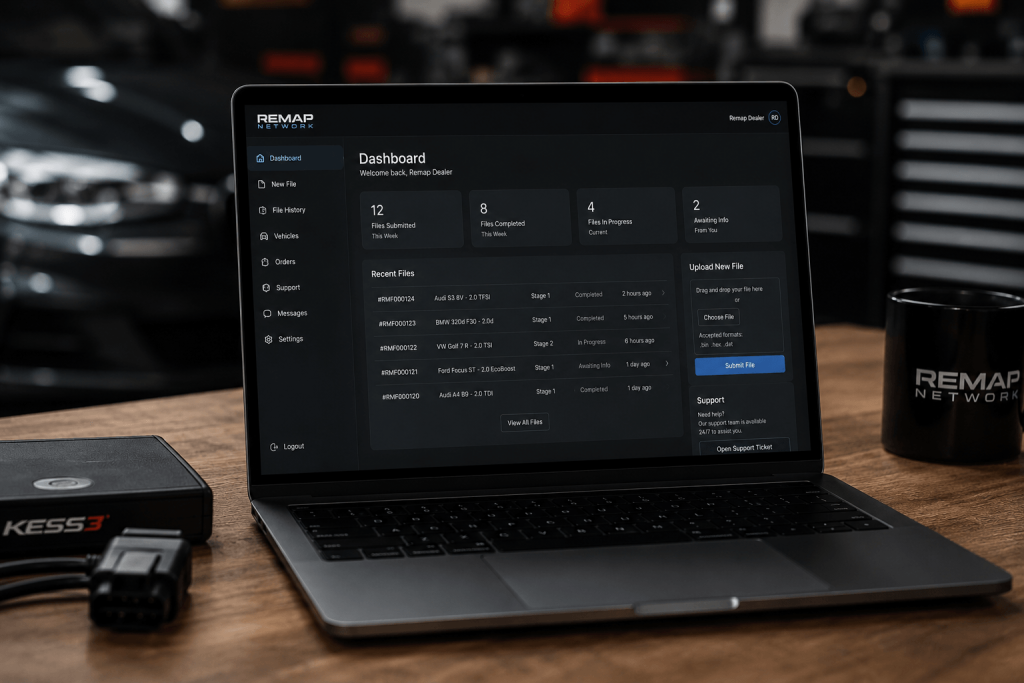
If you’ve spent any time around the UK remapping industry recently, you’ve probably noticed one thing very quickly. A huge number of remappers, tuning companies and dealer networks now rely on something called a remap file service.
Some businesses build their entire operation around them. Others quietly use them in the background while presenting themselves as standalone tuning companies. In reality, file services have become one of the biggest parts of the modern remapping industry.
But what actually is a remap file service?
How do they work behind the scenes? And why are so many remappers now using them instead of writing tuning files themselves?
At Remap Network, we work closely with remappers and tuning businesses across the UK every day. One thing that becomes obvious very quickly is that the industry has evolved massively over the last few years. Modern remapping is no longer just one technician working from a small garage with a laptop and a cable. It has become a huge ecosystem involving dealer networks, tuning tools, backend infrastructure and specialist calibration teams.
In this guide, we’re going to break everything down properly and explain exactly how remap file services work.
What Is A Remap File Service?
A remap file service is a business that supplies ECU tuning files to remappers, garages and tuning dealers.
Instead of modifying ECU files themselves, many remappers outsource the technical calibration work to a specialist provider. The remapper reads the original file from the vehicle, sends it to the file service, and receives a modified version back which is then written onto the car.
In simple terms, the file service handles the technical side of the remap.
This allows the dealer or workshop to focus on running the business, dealing with customers and fitting vehicles rather than spending years learning advanced ECU calibration.
This model has become incredibly common throughout the UK remapping industry.
Why File Services Have Become So Popular
Modern vehicles are far more complex than they used to be.
Years ago, many remappers were writing relatively basic files themselves. Today, modern ECUs are heavily encrypted, manufacturers constantly update software, and new protocols appear all the time. Proper calibration work now requires serious technical knowledge and expensive equipment.
For many remappers, outsourcing files simply makes more business sense.
It allows them to offer wider vehicle coverage, faster turnaround times and more specialist solutions without needing to become full-time calibration experts themselves.
A good file service essentially becomes the technical backbone of the operation.
This is one of the biggest reasons dealer networks have exploded in popularity over recent years.
How Does A Remap File Service Work?
The process itself is actually fairly straightforward.
First, the remapper connects a tuning tool to the vehicle and reads the original ECU file. This is usually done using tools such as Autotuner, Flex, KESS3 or CMDFlash.
Once the original file has been extracted, it gets uploaded to the file service. Depending on the company, this may happen through a dealer portal, cloud dashboard, WhatsApp support or dedicated tuning software.
The remapper will normally include details about the vehicle and the type of tune required. This could be:
- Stage 1 tuning
- Stage 2 tuning
- Gearbox tuning
- Pops and bangs
- Hardcut limiter
- DPF solutions
- EGR solutions
The file service then modifies the original calibration and sends the completed version back to the dealer. The remapper writes the new file onto the vehicle and the process is complete.
From the customer’s perspective, it all appears seamless.
Behind the scenes however, there is often an entire support and infrastructure system powering the operation.
What Is A Master Tuner?
One of the biggest misconceptions in the industry is that every remapper writes their own tuning files.
In reality, many successful remapping businesses outsource the calibration work to specialist tuners known as master tuners.
A master tuner is usually somebody with deep knowledge of ECU calibration. They understand:
- Torque limiters
- Fueling
- Boost pressure
- Airflow
- Ignition timing
- Gearbox behaviour
- ECU logic
Some file services employ their own in-house calibration teams. Others outsource to specialist tuners across Europe or the UK.
This is far more common than most people realise.
Why Dealer Networks Are Growing So Fast
One of the biggest changes within the remapping industry has been the rise of dealer networks.
A dealer network is essentially a collection of remappers operating under a shared infrastructure model. This may include shared file services, shared support systems, shared tools and shared dealer resources.
This is why you now see relatively small remapping brands operating nationwide dealer networks across the UK.
Many are leveraging existing backend infrastructure while focusing heavily on:
- Marketing
- Recruitment
- Customer acquisition
- Dealer relationships
- Business growth
The technical side is often handled elsewhere in the background.
Do Remappers Need To Write Their Own Files?
Not necessarily.
There is often a strange stigma within the industry where people assume that “real” remappers must write every file themselves. The reality is very different.
Running a successful remapping business requires far more than calibration knowledge alone. You still need customers, marketing, sales, operations, support and proper business systems.
Many highly successful tuning businesses outsource the backend calibration side completely while focusing on growing the front-end business.
This is extremely common throughout the industry today.
What Makes A Good File Service?
Not all file services are equal.
Some focus purely on speed. Others prioritise technical quality and long-term support. The best providers usually combine both.
In our experience, the strongest file services tend to offer:
- Fast turnaround times
- Reliable communication
- Stable files
- Broad vehicle coverage
- Consistent support
- Strong dealer relationships
Most dealers simply want reliability. If a file service replies quickly, solves problems and consistently delivers good files, dealers tend to stay loyal for years.
Support speed is particularly important.
Nobody wants a customer sitting around for hours while a workshop chases an unanswered file request.
What Tools Are Used With File Services?
Modern remapping revolves heavily around tuning tools.
Some of the most commonly used tools within the UK remapping industry include:
- Autotuner
- Magic Motorsport Flex
- KESS3
- CMDFlash
- Dimsport tools
Each tool supports different vehicles, protocols and tuning methods.
Some focus heavily on OBD tuning while others are better suited for bench or boot mode work. Choosing the right setup often depends on the type of vehicles being tuned and the business model being operated.
Are File Services Profitable?
For many businesses, yes.
This is one of the reasons why so many larger operators eventually shift their focus toward backend infrastructure and dealer systems rather than purely retail remapping.
A file service is highly scalable because it is primarily digital.
There is no stock, no shipping and no physical installation involved. Once a dealer network is established, file services can process large numbers of files daily with relatively low overheads.
This creates recurring usage and long-term dealer relationships, which can become extremely valuable over time.
Why The Industry Is Moving Towards Infrastructure
The modern remapping industry is becoming increasingly infrastructure-led.
Years ago, the typical model was one workshop serving local customers. Today, many larger businesses are building:
- Dealer networks
- File services
- Backend systems
- Technical support teams
- White-label infrastructure
The industry is becoming more sophisticated every year.
As tuning tools become more accessible and more garages add remapping services to their offering, demand for reliable file services continues to grow.
Final Thoughts
Remap file services now play a huge role within the modern tuning industry.
Behind many successful remapping businesses sits a much larger backend system involving file providers, dealer infrastructure and specialist calibration support.
Understanding how this ecosystem works is important whether you are:
- Starting a remapping business
- Running a garage
- Expanding into tuning
- Or simply trying to understand how modern dealer networks operate
The industry has changed massively over the last decade, and file services are now one of the biggest driving forces behind that evolution.
As the market continues to grow, dealer infrastructure, backend support and tuning networks will likely become even more important in the years ahead.