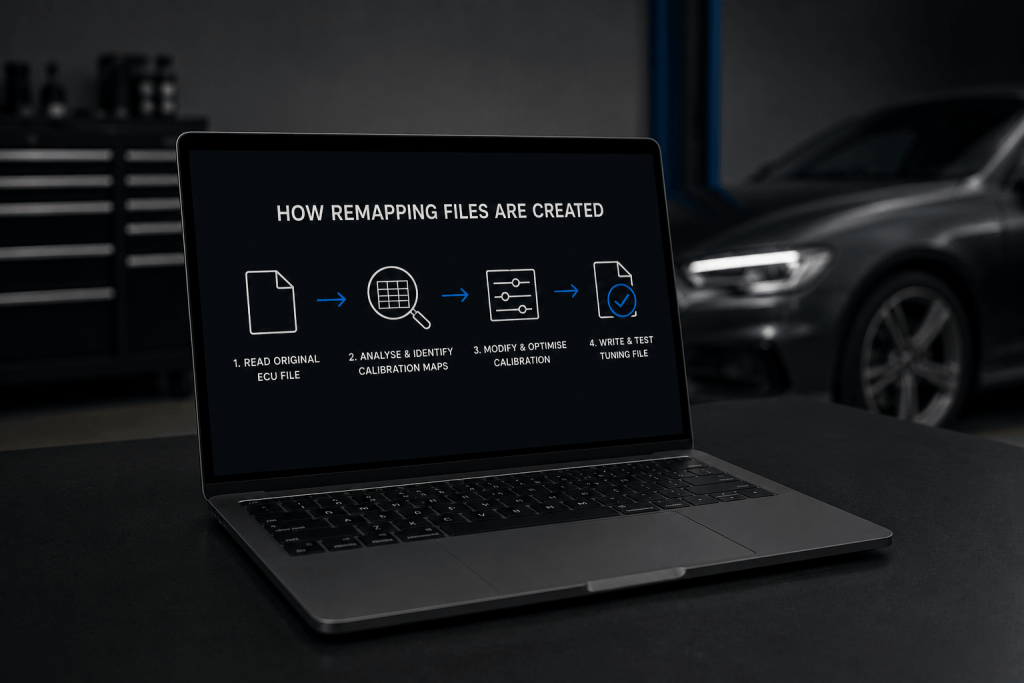
For most people outside the tuning industry, ECU remapping feels fairly simple.
A vehicle arrives at a workshop, a laptop gets plugged in, the remap is installed and the car leaves with more power shortly afterwards. What most customers never see however is the amount of technical work happening behind the scenes before that tuning file ever reaches the vehicle.
Modern remapping files are not randomly generated pieces of software. Proper calibration work requires technical knowledge, vehicle-specific development and an understanding of how modern engine management systems operate under load.
At Remap Network, we spend a huge amount of time around remappers, file providers and tuning businesses across the UK, and one thing becomes obvious very quickly. The backend side of the industry is significantly more sophisticated than most people realise.
In this guide, we’re going to explain how remapping files are actually created, what calibration specialists do behind the scenes and why modern ECU tuning has become such a specialised field.
Everything Starts With The Original ECU File
Every remap begins with reading the vehicle’s original ECU software.
The ECU, or Engine Control Unit, controls huge parts of how the vehicle operates. It manages things such as:
- Fuel delivery
- Boost pressure
- Torque management
- Airflow
- Ignition timing
- Throttle behaviour
Inside the ECU sits the factory calibration created by the manufacturer.
The first step in the remapping process is extracting that original file using a professional tuning tool such as:
- AutoTuner
- Flex
- KESS3
The original file is then either modified in-house or sent to a backend file provider or master tuner for calibration work.
Modern ECU Files Are Extremely Complex
One thing many people underestimate is how complicated modern ECU software has become.
Years ago, tuning was relatively basic compared to today’s standards. Modern vehicles however use advanced torque-based systems, encrypted ECUs and highly sophisticated management strategies.
A single ECU file may contain thousands of maps and tables controlling different aspects of the vehicle’s behaviour.
The tuner needs to identify which areas of the software are responsible for things such as:
- Torque requests
- Fuel pressure
- Turbocharger control
- Driver demand
- Airflow calculations
- Safety limitations
And more importantly, they need to understand how those systems interact together.
This is why proper calibration work requires genuine technical experience.
The Role Of ECU Calibration Software
Once the original file has been extracted, it gets opened inside specialist calibration software.
One of the most widely known platforms within the tuning industry is WinOLS. This type of software allows calibrators to analyse the ECU data and locate the maps controlling the vehicle’s behaviour.
This is where the actual tuning process begins.
The tuner identifies the relevant calibration maps and carefully adjusts values based on the desired outcome. This may involve improving:
- Power delivery
- Torque
- Throttle response
- Driveability
- Gearbox behaviour
Good calibration work is about creating a balanced result rather than simply increasing every value aggressively.
Why Safe Calibration Matters
One of the biggest misconceptions in remapping is that tuning is simply about making the highest power possible.
Experienced calibrators do not think that way.
A properly developed tuning file needs to account for:
- Engine limitations
- Turbocharger efficiency
- Fuel system capability
- Gearbox tolerances
- Exhaust gas temperatures
- Long-term drivability
A good remap should feel smooth and refined rather than unstable or aggressive.
This is why experienced master tuners place huge emphasis on balance and reliability during the calibration process.
Why Some Files Feel Better Than Others
Anyone who has driven multiple tuned vehicles quickly realises that some remaps simply feel better than others.
That usually comes down to calibration quality.
Two files may claim very similar power figures while delivering completely different driving experiences. One may feel smooth and OEM-like, while another feels jerky or unnatural under load.
The difference is often in the finer details of the calibration work itself.
Good tuners spend significant time refining:
- Torque delivery
- Pedal response
- Gearbox behaviour
- Power progression
- Thermal management
The strongest remaps often feel like a better version of the factory software rather than an obviously modified vehicle.
Why Many Remappers Outsource File Creation
One thing that surprises many people entering the industry is how many remappers outsource their tuning files.
Modern ECU calibration has become extremely specialised. Developing proper files requires:
- Technical knowledge
- Software expertise
- Ongoing testing
- Vehicle-specific experience
- Expensive development tools
Most workshops simply do not have the time or resources to handle that level of calibration work internally.
Instead, many rely on:
- File providers
- Master tuners
- Backend calibration teams
- Tuning portals
To handle the software side of the process.
This structure now powers a huge percentage of the modern remapping industry.
The Importance Of Vehicle-Specific Calibration
Not every vehicle behaves identically.
Even vehicles using the same engine can have:
- Different ECU software versions
- Different hardware
- Different gearbox setups
- Different operating conditions
A good calibration accounts for these differences rather than relying on overly generic tuning approaches.
This is one of the reasons experienced file providers and master tuners become so valuable within the industry.
Refined calibration work takes time and experience.
Why Modern Remapping Is Becoming Infrastructure-Led
The tuning industry today looks very different compared to ten years ago.
Years ago, remapping was mostly handled by small independent workshops. Today however, much of the industry runs through backend infrastructure involving:
- File services
- Calibration teams
- Dealer networks
- Tuning portals
- Technical support systems
Modern remapping businesses increasingly operate through connected backend ecosystems rather than isolated local setups.
This shift has allowed the industry to scale far faster than traditional workshop-only models ever could.
Why Testing Matters So Much
One of the most important parts of file creation is testing.
A proper tuning file should not simply work on paper. It needs to behave correctly in real-world driving conditions over time.
Experienced calibrators pay close attention to:
- Temperature control
- Torque delivery
- Gear changes
- Drivability
- Reliability under load
This is why experienced tuners often spend years refining specific vehicle platforms.
Good tuning is usually the result of ongoing development rather than quick one-time changes.
The Industry Continues To Evolve Rapidly
Modern vehicles are becoming increasingly software-driven.
Manufacturers continue introducing:
- More encryption
- More advanced ECUs
- More torque modelling
- More integrated systems
This means remapping itself is becoming more technical every year.
As a result, calibration specialists, backend file providers and infrastructure systems are becoming increasingly important throughout the industry.
Final Thoughts
Creating a remapping file involves far more than simply increasing power figures inside the ECU.
Modern calibration work requires technical knowledge, specialist software, testing and an understanding of how complex engine management systems behave under load. Behind every well-developed tuning file is usually a significant amount of backend development work most customers never see.
As the remapping industry continues evolving, proper calibration expertise and backend infrastructure are becoming more important than ever before.
The modern tuning world is increasingly built around systems, software and specialist knowledge operating quietly behind the scenes.