One of the biggest changes within the modern remapping industry has been the rise of tuning file portals.
Years ago, most tuning files were shared manually through email, forums or messaging apps. Today however, many professional remapping businesses and file providers operate through dedicated backend systems designed specifically for dealer support and file delivery.
If you spend enough time around the tuning industry, you’ll quickly realise that many successful dealer networks and ECU file services are powered almost entirely through these types of platforms.
At Remap Network, we work closely with remappers and tuning businesses across the UK every day, and one thing becomes very clear very quickly. The remapping industry is becoming increasingly infrastructure-led. Modern dealer operations now rely heavily on backend systems, technical support and organised workflows rather than simply one tuner working from a laptop alone.
Tuning file portals now sit at the centre of that infrastructure.
In this guide, we’re going to explain exactly how tuning file portals work, why they’ve become so important and how they power many modern remapping businesses behind the scenes.
What Is A Tuning File Portal?
A tuning file portal is an online platform used by remappers and file providers to manage ECU tuning files.
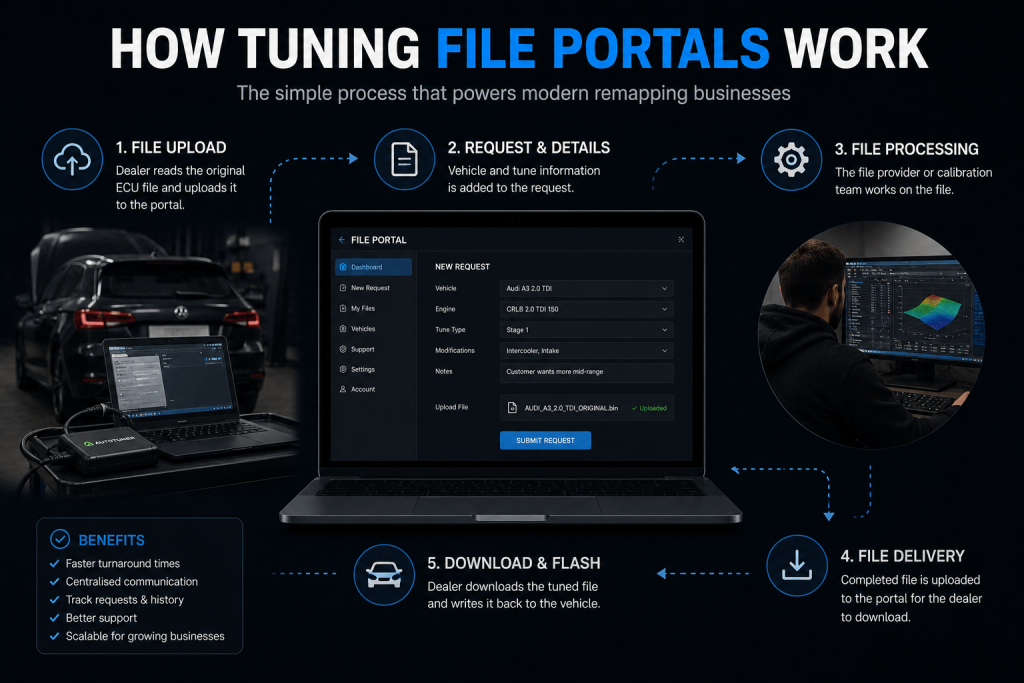
Instead of manually sending files through email or WhatsApp, the dealer uploads the original ECU file directly into the portal. The backend calibration team or file provider then modifies the calibration and uploads the completed tuning file back into the system ready for download.
In simple terms, the portal acts as the central hub connecting:
- Dealers
- File providers
- Calibration teams
- Support systems
Everything becomes more organised, faster and easier to manage at scale.
Why Tuning File Portals Became So Popular
The biggest reason is scalability.
As dealer networks and file services grew, manually handling files through email or messaging apps became increasingly inefficient. Once providers begin supporting large numbers of dealers daily, backend organisation becomes essential.
A proper file portal allows providers to:
- Track file requests
- Manage dealer accounts
- Organise vehicle data
- Monitor job status
- Deliver files faster
- Centralise communication
This creates a far smoother workflow for both the dealer and the backend provider.
Modern tuning businesses now rely heavily on this type of infrastructure.
How The Process Usually Works
The workflow itself is relatively straightforward.
The remapper first reads the original ECU file from the vehicle using a tuning tool such as AutoTuner, Flex or KESS3. Once the file has been extracted, it gets uploaded into the tuning portal.
The dealer then enters information about:
- The vehicle
- Engine type
- Requested tune
- Hardware modifications
- Any special requests
The file provider or calibration team receives the request through the backend system and begins working on the file.
Once completed, the modified tuning file is uploaded back into the portal where the dealer can download it and write it onto the vehicle.
From the customer’s perspective, the process usually appears seamless.
Behind the scenes however, there may be an entire support infrastructure operating through the portal itself.
Why File Portals Are Important For Dealer Networks
Dealer networks have grown massively throughout the UK remapping industry over recent years.
As networks scale, organisation becomes increasingly important. Managing dozens or even hundreds of dealers manually through scattered communication channels quickly becomes chaotic.
This is where tuning portals become incredibly valuable.
A proper backend system allows networks to:
- Standardise workflows
- Improve support speed
- Manage dealer activity
- Deliver files efficiently
- Scale operations properly
Without strong infrastructure, large dealer systems become very difficult to manage long term.
This is one of the reasons modern remapping businesses are becoming increasingly software and systems-driven.
Why Speed Matters So Much
One of the biggest priorities within the tuning industry is turnaround time.
Customers do not want their vehicle sitting around all day waiting for a file. Workshops and mobile remappers need fast responses in order to keep operations moving efficiently.
A strong tuning file portal helps improve speed by:
- Organising requests properly
- Reducing communication delays
- Streamlining file delivery
- Centralising support systems
The smoother the backend workflow becomes, the easier it is for dealers to handle larger customer volumes.
This is why many larger file services invest heavily into backend portal infrastructure.
Good Portals Create Better Dealer Support
One thing many newer remappers underestimate is how important backend support becomes once a business starts growing.
Good tuning portals usually include features such as:
- Live support
- File tracking
- Request history
- Vehicle logs
- Dealer management
- Technical communication
These systems help create a much smoother dealer experience overall.
Strong support infrastructure becomes a huge competitive advantage within the remapping industry.
Why The Industry Is Becoming Infrastructure-Led
The tuning industry has evolved massively over the last decade.
Years ago, most remappers operated as isolated local workshops. Today however, many operators are building:
- Dealer networks
- File service platforms
- Backend infrastructure
- White-label systems
- National support operations
Modern remapping businesses now rely heavily on systems and infrastructure rather than purely technical tuning ability alone.
This shift is one of the biggest reasons backend platforms and tuning portals have become so important.
Not All File Portals Are Equal
Some tuning portals are extremely basic.
Others are highly advanced systems built specifically to support large-scale dealer operations.
The strongest platforms usually focus heavily on:
- Stability
- Speed
- Ease of use
- Dealer support
- Workflow efficiency
- Communication systems
A poorly organised backend system creates friction very quickly, especially as dealer numbers grow.
The best portals make the entire process feel smooth and professional for everyone involved.
Why Many Dealers Never See The Backend Complexity
From the outside, modern remapping often looks fairly simple.
A customer sees a workshop connect a tuning tool to the car, upload something on a laptop and then flash the modified file onto the vehicle.
What many people never see however is the amount of infrastructure often sitting behind that process.
There may be:
- Calibration teams
- Backend support staff
- Dealer systems
- Technical infrastructure
- Cloud-based workflows
- File management systems
All operating quietly behind the scenes through the portal itself.
This backend infrastructure is now powering a huge percentage of the modern tuning industry.
Final Thoughts
Tuning file portals have become one of the most important parts of modern remapping infrastructure.
As dealer networks and ECU file services continue growing, backend systems are becoming increasingly essential for managing support, communication and file delivery efficiently.
The industry today is far more organised and infrastructure-driven than many people realise. Modern tuning businesses are no longer simply workshops fitting remaps locally. Many are now operating through sophisticated backend systems designed to support dealers across entire regions or countries.
As the remapping industry continues evolving, tuning file portals and backend infrastructure will likely become even more important moving forward.