Most people looking into the remapping industry assume the same thing at first.
They picture one tuner sitting behind a laptop, manually building every file themselves from scratch before flashing it onto the vehicle. Years ago, that was often fairly close to reality. Today however, the industry operates very differently.
Modern remapping has become heavily infrastructure-driven. Behind many successful tuning businesses now sits a much larger backend system involving dealer networks, file providers, calibration specialists and support teams. In many cases, the workshop fitting the remap is not actually writing the tuning file themselves at all.
That’s where ECU file services come in.
At Remap Network, we work closely with remappers and tuning businesses across the UK, and one thing has become very obvious over the last few years. The industry has evolved rapidly. Some businesses have adapted to that shift extremely well. Others are still operating as though it’s 2012.
If you are trying to understand how the modern tuning industry actually works behind the scenes, understanding ECU file services is essential.
What Is An ECU File Service?
An ECU file service is a business that supplies modified tuning files to remappers, garages and tuning dealers.
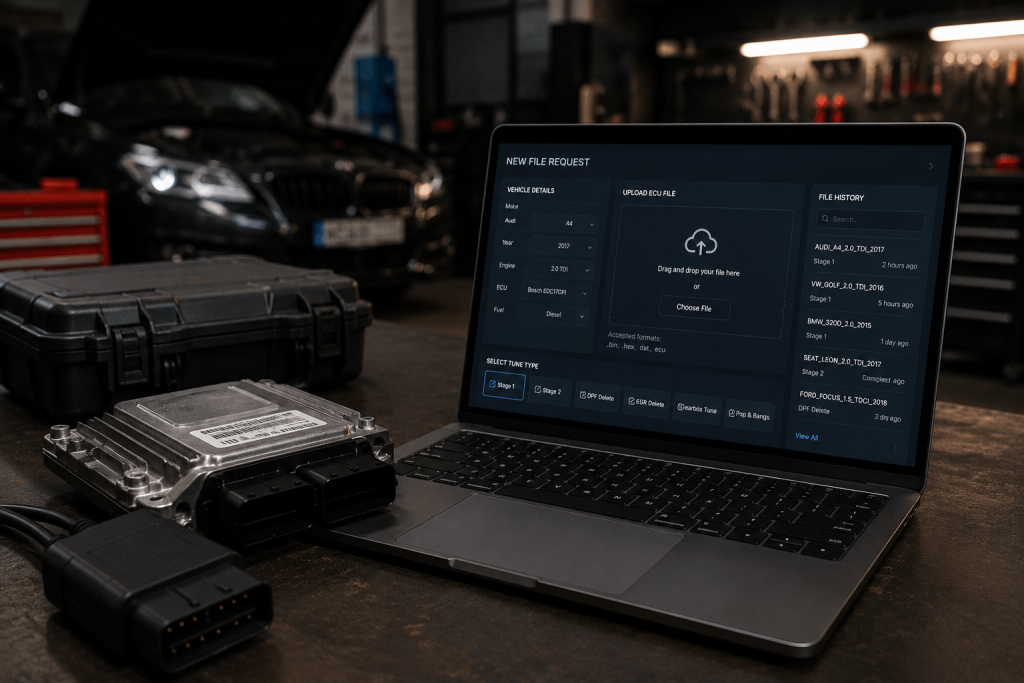
The remapper reads the original ECU software from the vehicle and sends that file to a specialist provider. The file service then modifies the calibration based on the requested tune before sending the completed file back ready to be written onto the vehicle.
In simple terms, the file service handles the backend technical side of the remap.
This allows the remapper to focus on running the business itself. Customer acquisition, vehicle installs, workshop operations and lead generation become the priority, while the calibration work is handled elsewhere in the background.
This model has become incredibly common throughout the UK remapping industry.
Why ECU File Services Became So Popular
The biggest reason is complexity.
Modern vehicles are significantly more advanced than they were even ten years ago. Manufacturers now use heavily encrypted ECUs, advanced torque modelling and increasingly complicated engine management systems. Writing safe and reliable tuning files requires a huge amount of knowledge, testing and development work.
For many remappers, trying to become an expert calibrator simply no longer makes commercial sense.
Learning proper ECU calibration takes years. Not only that, but it also requires expensive tools, software licences, test vehicles and constant development work across hundreds of vehicle platforms.
Most tuning businesses would rather focus on building a profitable operation than spending years deep inside WinOLS.
That shift is exactly why ECU file services exploded in popularity.
How The Process Actually Works
The process itself is relatively straightforward from the dealer’s perspective.
The remapper first reads the original ECU file from the vehicle using a tuning tool. This is usually done using systems such as Autotuner, Flex or KESS3. Once the original file has been extracted, it gets uploaded to the file service through a portal, dashboard or support system.
The remapper then specifies what they want done to the vehicle. That may be a basic Stage 1 remap, a Stage 2 calibration, gearbox tuning or another modification request entirely.
The file service modifies the calibration and sends the completed file back to the dealer. The remapper then writes the tuned file onto the vehicle and the job is complete.
From the customer’s perspective, the entire process often looks seamless. They rarely see the backend infrastructure powering it.
In reality however, many file services are surprisingly sophisticated operations.
The Rise Of Backend Infrastructure In Remapping
One of the biggest changes in the industry over recent years has been the move toward backend infrastructure businesses.
Years ago, most remappers operated as small independent workshops serving local customers directly. Today however, many larger businesses are building scalable dealer systems instead.
Some companies now focus almost entirely on:
- Dealer support
- File delivery
- Technical infrastructure
- White-label systems
- Backend operations
Rather than retail remapping itself.
This is why relatively small tuning brands can suddenly appear with nationwide dealer coverage and extensive support systems. The frontend business may look small, but the backend infrastructure supporting it can be much larger than people realise.
Many businesses now leverage shared backend systems while focusing primarily on dealer recruitment, marketing and growth.
What Is A Master Tuner?
One of the biggest misconceptions in the industry is that every successful remapper writes their own files.
That simply is not true.
Many tuning businesses outsource calibration work to specialist tuners known as master tuners. These are the people with deep technical knowledge of ECU calibration and engine management systems.
A good master tuner understands things like torque control, fueling, ignition timing, airflow, boost pressure and gearbox behaviour at a very high level.
Some ECU file services employ their own in-house calibration teams. Others outsource work to specialist tuners elsewhere in the UK or Europe.
This type of structure is now extremely common throughout the industry.
Why Some Remappers Scale Faster Than Others
One interesting thing about the tuning industry is that technical skill alone does not always determine who grows the biggest business.
Some excellent calibrators remain relatively small local operations for years. Meanwhile, other businesses scale rapidly despite outsourcing most of the backend tuning work entirely.
Why?
Because modern remapping is no longer just about tuning files.
The businesses growing fastest today usually focus heavily on:
- Marketing
- Lead generation
- Customer handling
- Dealer relationships
- Systems
- Operations
- Infrastructure
The calibration side is only one part of the puzzle now.
This is why dealer networks and backend infrastructure have become such powerful business models within the industry.
What Makes A Good ECU File Service?
Most dealers are not looking for flashy branding or hype. They want reliability.
A good ECU file service consistently delivers stable files, responds quickly and provides dependable support when problems arise.
Speed matters massively within this industry. Customers do not want to sit around all day while workshops chase unanswered file requests. If support is slow or communication breaks down, dealers quickly lose confidence.
The strongest file services understand this.
They focus heavily on communication, turnaround times and dealer relationships just as much as the technical side itself.
In many ways, the support system becomes just as important as the tuning files.
Why The Industry Continues To Grow
Demand for remapping continues growing across the UK.
More garages are adding tuning services to increase revenue. Mobile remapping businesses are expanding rapidly, and tuning tools are becoming more accessible every year.
As that happens, demand for backend support naturally increases alongside it.
Not every workshop wants to become a full-scale calibration house. Most simply want a reliable backend provider they can trust long term while they focus on building the front-end business.
That trend is unlikely to slow down any time soon.
Final Thoughts
ECU file services now sit at the centre of the modern remapping industry.
Behind many successful tuning businesses is a much larger ecosystem involving calibration specialists, backend systems and dealer infrastructure. What looks like a simple remap from the outside is often powered by an entire support network operating quietly in the background.
For anybody looking to understand how modern remapping actually works, ECU file services are one of the most important parts of the industry to understand.
The market has evolved massively over the last decade, and backend infrastructure is now shaping the future of tuning more than ever before.