Over the last few years, remap dealer networks have become one of the fastest-growing parts of the UK tuning industry.
You’ve probably seen it yourself. Small remapping brands suddenly appear with dealers covering multiple cities across the country. Some have nationwide websites, branded support systems and large vehicle coverage despite looking relatively small from the outside.
To somebody unfamiliar with the industry, it can seem confusing.
How does one tuning company suddenly have dealers operating all over the UK?
Are they all writing their own files? Do they all work together? Who actually handles the tuning side of things?
At Remap Network, we spend a huge amount of time around remappers, garages and tuning businesses across the UK, and one thing becomes obvious very quickly. Modern remapping has become heavily infrastructure-led. Dealer networks now play a massive role in how the industry operates behind the scenes.
In this guide, we’re going to break down exactly how remap dealer networks work, why they’ve become so popular and what’s actually happening underneath the surface.
What Is A Remap Dealer Network?
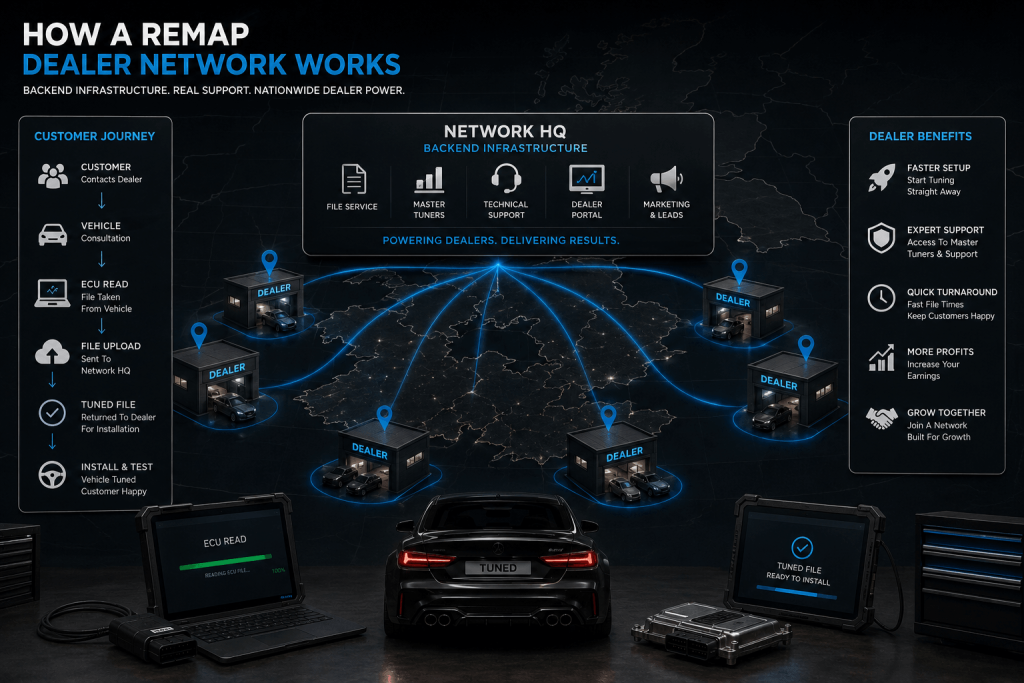
A remap dealer network is a group of remappers or tuning businesses operating under a shared infrastructure system.
The network itself usually provides some combination of:
- Branding
- Backend support
- File services
- Lead generation
- Technical support
- Dealer systems
- Operational infrastructure
The dealer handles the customer-facing side of the business locally, while the network provides support and backend systems behind the scenes.
This model has become increasingly common throughout the UK remapping industry over recent years.
Why Dealer Networks Became So Popular
The remapping industry has changed massively over the last decade.
Years ago, most tuning businesses were relatively small independent workshops serving local customers directly. Modern remapping however has become far more complicated than it used to be.
Vehicles are now:
- More heavily encrypted
- More software-driven
- More technically advanced
- More difficult to calibrate properly
At the same time, competition within the industry has increased significantly.
This created a natural shift toward infrastructure and backend support systems.
Instead of every remapper trying to build everything themselves from scratch, many now plug into existing dealer networks which already provide:
- Backend calibration
- File support
- Systems
- Branding
- Technical infrastructure
This allows dealers to scale much faster than operating entirely alone.
How The Dealer Model Usually Works
Most dealer networks follow a fairly similar structure.
The dealer handles:
- Customers
- Vehicle installs
- Workshop operations
- Mobile appointments
- Sales and enquiries
Meanwhile, the network itself may handle:
- File delivery
- Technical support
- Backend systems
- Marketing infrastructure
- Dealer onboarding
- Operational support
This creates a split between the front-end business and the backend infrastructure powering it.
From the customer’s perspective however, everything usually appears seamless.
Most customers never realise how much backend support exists behind modern tuning businesses.
The Role Of ECU File Services
One of the biggest parts of most dealer networks is the ECU file service.
Many dealers do not write their own tuning files themselves. Instead, the original ECU file gets uploaded to a backend provider who handles the calibration work before returning the completed file ready to flash onto the vehicle.
This has become standard practice across huge parts of the industry.
Modern ECU calibration requires extensive technical knowledge, expensive development tools and constant testing across hundreds of vehicle platforms. Most workshops simply do not have the resources to handle all of that internally.
This is why backend file services became such an important part of dealer infrastructure.
Why Some Dealer Networks Scale Extremely Fast
One thing that surprises many people entering the industry is how quickly some dealer networks grow.
The reason is fairly simple.
Dealer networks are highly scalable once the backend infrastructure exists.
A network may only need:
- One backend file system
- One calibration team
- One support structure
- One operational process
…while supporting dealers across dozens of locations simultaneously.
This is very different to traditional workshop-only business models where growth is heavily tied to physical location and staffing.
Infrastructure scales far faster than local-only operations.
Why Many Dealers Join Networks
For many remappers and garages, joining a dealer network removes a huge amount of complexity.
Instead of needing to build everything independently, dealers gain access to systems that already exist.
This may include:
- Backend tuning support
- Technical assistance
- Dealer resources
- Lead generation
- Branding systems
- Training
- Operational guidance
For newer operators especially, this can dramatically reduce the learning curve involved in building a tuning business from scratch.
Even experienced workshops often join networks simply because the infrastructure allows them to scale faster.
Why Backend Support Matters So Much
One of the biggest misconceptions in the tuning industry is that remapping is only about technical tuning knowledge.
In reality, successful dealer networks rely heavily on operations and support systems.
A dealer with poor support behind them will usually struggle regardless of technical ability.
Things like:
- Fast communication
- File turnaround speed
- Problem resolution
- Dealer support
- Customer handling
…become incredibly important as networks grow.
The strongest dealer networks understand this and focus heavily on backend infrastructure rather than simply tuning files alone.
The Difference Between Good And Bad Dealer Networks
Not all dealer networks are equal.
Some are built properly with strong infrastructure and long-term dealer support in place. Others are little more than loose reseller systems with minimal backend structure.
The strongest networks usually focus heavily on:
- Reliability
- Support
- Consistency
- Dealer communication
- Technical stability
- Long-term relationships
Most successful dealers eventually realise that strong backend systems are often more valuable than flashy marketing.
A reliable infrastructure creates confidence and stability, which becomes increasingly important as customer volume grows.
Why The Industry Is Becoming More Infrastructure-Led
The modern remapping industry is moving heavily toward infrastructure-based business models.
Years ago, most businesses operated as isolated local workshops. Today however, many operators are building:
- Nationwide dealer networks
- White-label systems
- Backend support operations
- Technical infrastructure platforms
- Shared file systems
This shift allows businesses to scale far beyond what traditional workshop-only models could realistically achieve.
It’s also one of the reasons why the remapping industry looks very different today compared to ten years ago.
Why Reputation Matters So Much Within Dealer Networks
One thing that becomes obvious very quickly in this industry is that reputation spreads fast.
A network providing:
- Reliable support
- Stable files
- Good communication
- Fast turnaround times
…will naturally retain dealers far longer than networks focused purely on aggressive growth.
Most experienced remappers eventually realise that backend reliability matters far more than hype.
Once dealers find infrastructure they trust, they usually stay loyal to it long term.
Final Thoughts
Remap dealer networks now play a huge role within the modern tuning industry.
Behind many successful remapping businesses sits an entire backend ecosystem involving calibration support, file services, technical infrastructure and operational systems. While customers may only see the local workshop or mobile tuner, there is often a much larger support structure operating quietly in the background.
As the industry continues evolving, dealer infrastructure and backend systems will likely become even more important moving forward.
Modern remapping is no longer simply about tuning cars. It’s increasingly about building scalable systems, support networks and backend infrastructure around the businesses doing the work.