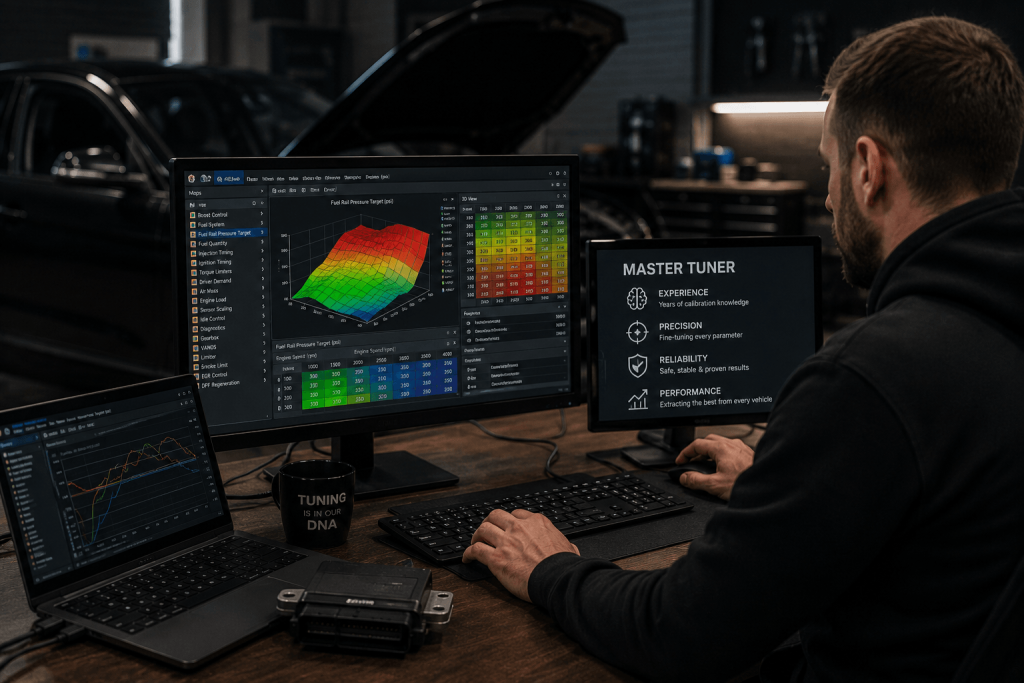
Spend enough time around the remapping industry, and you’ll eventually hear the term “master tuner” mentioned constantly.
For people outside the industry, the phrase can sound almost mysterious. Some assume it simply means an experienced remapper. Others think it refers to the owner of a tuning company. In reality, the role is far more specific than that.
A master tuner is usually the person responsible for the actual ECU calibration work behind the scenes. While the workshop or mobile remapper may deal directly with the customer, the master tuner is often the person developing and modifying the tuning file itself.
At Remap Network, we speak with tuning businesses across the UK every day, and one thing becomes obvious very quickly. Modern remapping is no longer a simple one-man operation. The industry has evolved into an entire ecosystem involving dealers, workshops, backend infrastructure providers and specialist calibrators.
Master tuners now sit right in the middle of that system.
The Modern Remapping Industry Works Very Differently Today
Years ago, most remapping businesses were relatively small operations. One workshop, one technician and a fairly limited range of vehicles. The same person fitting the remap was often also building the tuning files themselves.
Modern vehicles changed that completely.
Today’s ECUs are significantly more advanced than they were even ten years ago. Manufacturers now use highly encrypted software, complex torque modelling systems and increasingly sophisticated engine management strategies. Proper calibration work has become extremely technical.
As the industry evolved, businesses naturally began specialising in different areas.
Some focused on customer acquisition and workshop operations. Others focused entirely on ECU development and calibration work. This is where the role of the master tuner became far more important.
What Does A Master Tuner Actually Do?
A master tuner works directly with ECU software and calibration maps.
Their role is to modify the vehicle’s software safely and effectively in order to improve things such as power delivery, torque, throttle response and overall driveability. This involves far more than simply increasing numbers inside the ECU.
Good calibration work requires a deep understanding of how modern engines, gearboxes and management systems behave under different conditions.
A proper tuner must understand:
- Fuel delivery
- Boost control
- Torque management
- Airflow calculations
- Ignition timing
- Gearbox behaviour
- Thermal limitations
And more importantly, they must understand how all of those systems interact together.
This is why genuine calibration experience becomes so valuable.
The Difference Between A Remapper And A Master Tuner
This is where many people become confused.
Not every remapper is a master tuner.
A remapper may run a successful tuning business, fit remaps daily and handle customers professionally while still outsourcing the calibration side of the process to a backend specialist.
That is extremely common throughout the UK remapping industry today.
Many businesses focus primarily on:
- Workshop operations
- Customer service
- Lead generation
- Mobile tuning
- Dealer growth
While relying on experienced backend calibrators to handle the technical software side.
In reality, modern remapping has become heavily infrastructure-led.
Why Master Tuners Became So Important
The biggest reason is vehicle complexity.
Years ago, tuning was far simpler than it is today. Modern vehicles however require a huge amount of ongoing development work and technical understanding.
Manufacturers constantly release new ECU versions, software updates and encrypted systems. Keeping up with that level of development requires serious time and investment.
Most workshops simply do not have the resources to:
- Develop every platform internally
- Test every ECU variation
- Maintain advanced calibration knowledge
- Build files for hundreds of vehicles
This is why specialist backend calibrators became such an important part of the industry.
Master tuners allow workshops and dealers to access advanced calibration support without needing to become full-time ECU developers themselves.
How Master Tuners Work With File Services
In many cases, master tuners work behind the scenes through ECU file services.
The workshop reads the original ECU file from the vehicle and uploads it through a dealer portal or backend support system. The master tuner then modifies the calibration before returning the completed file ready to be written onto the vehicle.
From the customer’s perspective, the process usually appears seamless.
Most vehicle owners never even realise there may be multiple businesses involved behind the scenes.
This type of structure now powers a huge percentage of the modern remapping industry.
Why Experience Matters So Much In Calibration
One thing people quickly learn within the tuning world is that not all files are equal.
Two different files may claim identical power figures while delivering completely different driving experiences.
An experienced master tuner understands how to create calibrations that feel:
- Smooth
- Predictable
- Stable
- Reliable
- OEM-like in delivery
That level of refinement only comes through years of experience and real-world testing.
Good tuning is not about pushing every vehicle to its absolute limit. The best calibrations usually feel natural and balanced rather than aggressive or unstable.
This is why reputation becomes so important within the industry.
Why Some Master Tuners Become Well Known
Within the remapping industry, strong reputations travel quickly.
A tuner who consistently delivers reliable files and solves technical problems efficiently will naturally attract more dealers and backend partnerships over time.
This is one of the reasons some backend operators end up supporting:
- Large dealer networks
- Hundreds of tuning businesses
- National infrastructure systems
- White-label operations
The technical side of the industry becomes heavily relationship-driven once businesses start scaling.
Trust matters massively.
The Industry Is Moving Towards Infrastructure
One of the biggest changes within the UK tuning industry is the rise of backend infrastructure businesses.
Years ago, most tuning businesses operated as isolated local workshops. Today however, many larger operators are building entire backend systems involving:
- Dealer networks
- File services
- Technical support teams
- Calibration infrastructure
- White-label systems
Master tuners now play a central role within many of these operations.
Without strong calibration support behind the scenes, large dealer systems become very difficult to scale properly.
Why Most Workshops Never Become Master Tuners
For many businesses, becoming a master tuner is not actually necessary.
Learning proper ECU calibration takes years and requires significant investment into software, tools, testing and vehicle development. Many workshop owners would rather focus on growing the business itself rather than becoming full-time calibrators.
That’s why outsourcing files has become standard practice across much of the industry.
Modern remapping is no longer simply about technical knowledge alone. Business systems, customer acquisition and infrastructure now play an equally important role in determining which companies grow successfully.
Final Thoughts
Master tuners sit behind a huge percentage of the modern remapping industry, even if most customers never realise it.
While the workshop or mobile remapper may handle the customer-facing side of the process, the calibration work itself is often being developed by specialist backend tuners with years of technical experience.
As the industry continues evolving, backend infrastructure and specialist calibration support are becoming more important than ever before.
Understanding the role of the master tuner gives a much clearer picture of how modern remapping businesses actually operate behind the scenes.